Read the controller's battery specification
Check whether the controller accepts user-replaceable cells, a specific rechargeable pack or only an internal battery. Do not substitute a pack because its outline resembles the original. Voltage, chemistry, contacts and charging behavior all belong to the exact supported arrangement.
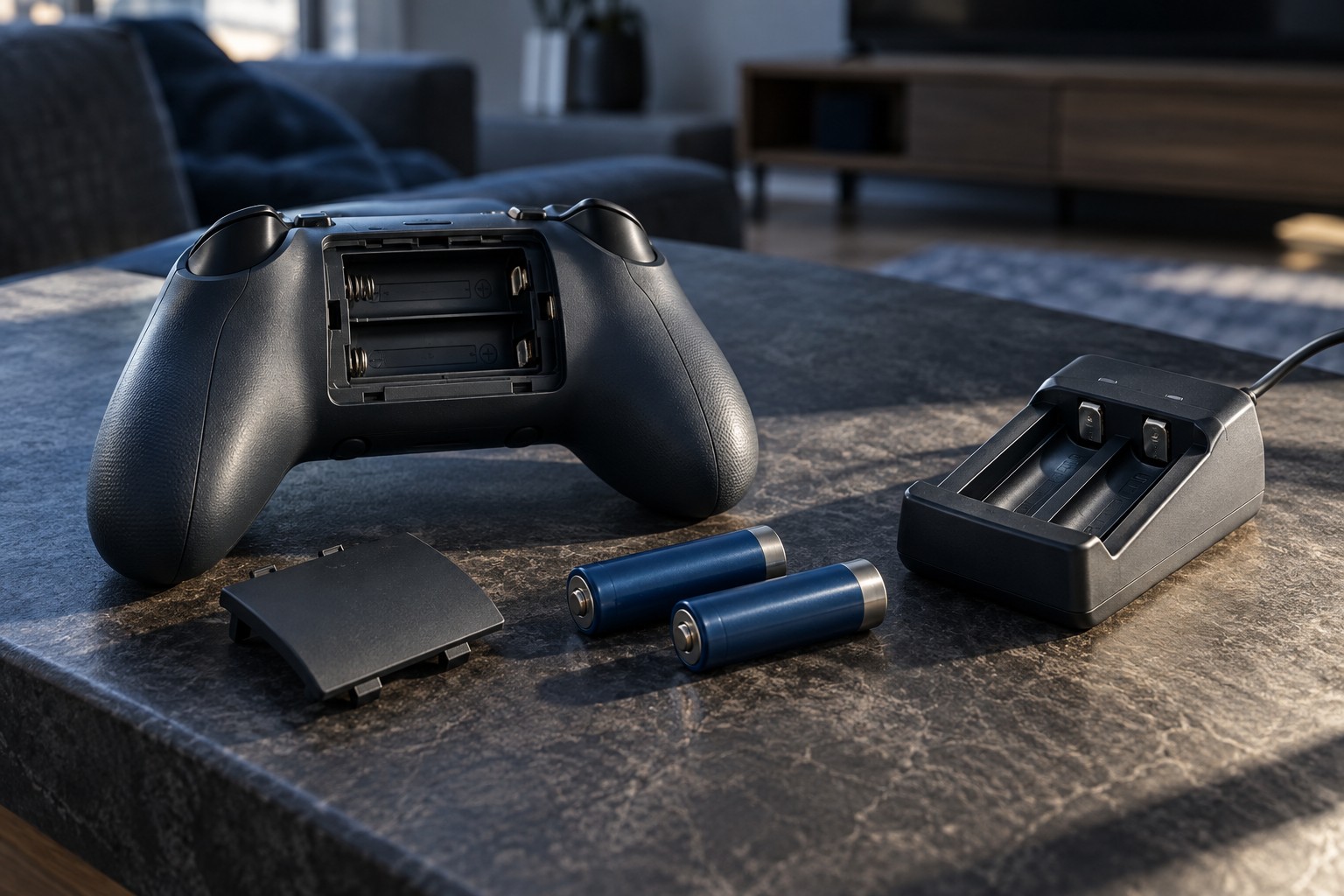
If the controller accepts AA-size cells, read which types the manufacturer permits. A lithium rechargeable cell sold in a familiar size can have different electrical characteristics from another rechargeable chemistry. Use the documented type rather than assuming that all products labeled rechargeable are equivalent.
Keep charging separate from powering
A controller can operate from a battery without being able to recharge it through its USB socket. Check the manual's charging statement explicitly. If removable cells require an external charger, take them out and use the correct charger according to the battery and charger instructions.
A proprietary rechargeable pack may support charging through the controller or a matching dock, but that behavior should not be generalized to loose cells. Third-party packs can have their own charging connection. Keep the pack and charger model information together so the supported pair remains clear.
Do not mix battery chemistries or use a charger not intended for the cells. Keep sets organized as directed by their manufacturer and inspect for damage before use. Store loose batteries so their contacts cannot be bridged by coins, keys or other metal objects.
Plan a manageable rotation
If using replaceable rechargeable sets, choose a clear location for charged and depleted cells. A small labeled case can avoid guessing from memory. Charge in the conditions specified by the maker and remove or store the cells as instructed when the equipment will be unused for an extended period.
Battery indicators can behave differently with different supported battery types, so learn how the controller reports the arrangement you use. Do not treat a surprising percentage alone as proof of a fault, but investigate repeated shutdowns or abnormal behavior through the manufacturer's support guidance.
Include replacement availability and the cost of a proper charger in the purchase. A supported system that is easy to maintain is more useful than a cheap pack with unclear charging instructions. The aim is predictable power from compatible components, with no assumption that a USB cable or matching shape guarantees safe recharging.