Distinguish the feel categories
Linear switches move through their travel without an intentional tactile bump. Tactile switches include a noticeable change in resistance, while clicky designs add a deliberate click mechanism. These categories help describe a preference, but switch colors are not a universal standard across manufacturers. Read the actual description instead of assuming that every red, brown or blue switch behaves the same way.
Actuation force, travel and the position of a bump can differ within a category. A light switch may register with less effort, yet it may also be easier for you to press unintentionally when resting a finger. A heavier one may feel more deliberate but require more effort over repeated presses. Try the complete action rather than comparing only one force number.
A sample is useful but incomplete
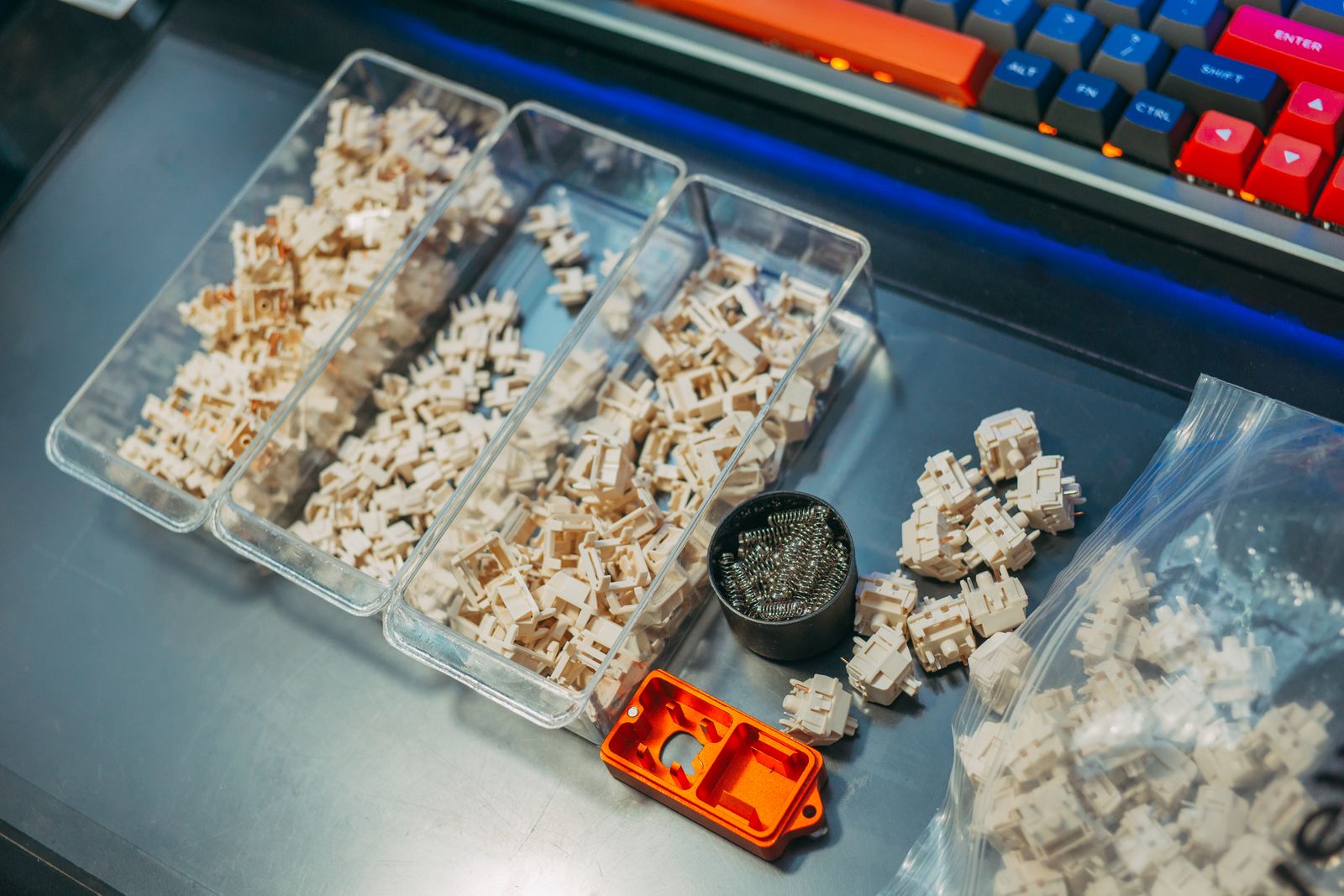
A switch tester can help you reject a feel you clearly dislike. It does not reproduce the sound of a full keyboard, its stabilizers or the way a long key behaves. A spacebar can sound different from a letter key even when both use the same switch type. If sound matters, seek a sample of the actual board or a recording made under comparable conditions.
Online sound demonstrations vary with microphone position, room acoustics and recording processing. Use them to notice broad differences rather than to predict an exact loudness at your desk. A quiet-looking product photograph says nothing about how the board will sound in a shared room.
Bottoming out is another part of the experience. A switch can actuate before the key reaches the end of its travel, but many people still press to the bottom during normal typing. Compare how the full press and release feel, including any impact sound, instead of concentrating only on the actuation point.
Choose within the keyboard's limits
If you plan to change switches later, verify the keyboard's supported switch system. Hot-swap does not make optical, magnetic, low-profile and conventional mechanical switches interchangeable. Even within a broad category, the maker may specify particular compatible families. Check this before buying a large switch pack.
For a first board, prioritize a feel you can use comfortably across both games and everyday typing. A switch chosen solely for a claimed competitive advantage may not suit writing, menus or shared-room use. Keep a note of the exact switch name and board configuration when trying examples so that you can reproduce the combination you liked.
Treat the purchase as a complete keyboard choice. Case construction, stabilizers, keycaps and layout all contribute to the result. A preferred switch is a useful starting point, but it cannot guarantee that every keyboard containing it will feel or sound the same.